In September 2022, Google’s Equiano undersea cable (also referred to as subsea cable or submarine cable) was launched after its initial announcement in 2019. The project was framed as a technological breakthrough that would transform Africa’s digital connections. With a $1 billion investment, the cable stretches 15,000km from Sesimbra, Portugal to Cape Town, South Africa along the west coast of Africa, with branching points in Lagos, Lome, Swakopmund (Namibia) and Rupert’s Bay (St. Helena), and promises to provide internet speeds 20 times faster than existing infrastructure.
“We’re excited to bring Equiano online,” declared Google’s PR blog as they announced the naming of the cable after Olaudah Equiano, the Nigerian-born abolitionist who was enslaved as a boy. If these routes sound uncomfortably familiar, it is because the cable’s path eerily mirrors transatlantic slave trading routes. A year after its launch, the Equiano cable emerged as a “lifeline” in several technological media framings during a major internet outage in March 2024, when four other undersea cables connecting Africa to Europe failed.
Like a Pandora’s box of tech expansionist missions, technology practitioners Esther Mwemba and Abeba Birhane have written about the deep vulnerabilities created by African nations’ reliance on privately-owned digital infrastructure. This creates a case of perpetual “infrastructure debt” – where African countries must pay private corporations to access connectivity through cables laid in their own territorial waters, while having little say in how their data flows through these networks. As private companies like Google embed themselves into social, governmental, and institutional structures in opaque ways, without public education and often without the consent of the people, this becomes a practical example of digital colonialism. I define digital colonialism here as a system of dehumanization and exploitation where Big Tech companies extract resources and labor from Africa while extending forms of algorithmic control over African digital spaces, altering kinship, sovereignty, and the imaginary.
In this presentation, I reflect particularly on Google’s naming tradition as a racial capitalist attempt to whitewash colonial history and oceanic imaginaries under the guise of improving internet speeds and reducing data costs – an act that commodifies Equiano and confines him to the bottom of the ocean. I reflect especially on the stakes of digital colonialism from an African feminist decolonial perspective.
Sierra Leonean scholar Filomina Chioma Steady offered, in 1996, one of the most critical descriptions of African feminism as emerging from “polarizations and conflicts that represent some of the worst and chronic forms of human suffering.” African feminism is, for her, a humanistic feminism through which women are viewed first and foremost as human. This humanistic ethos emerges from what Patricia McFadden describes as a feminist subjectivity rooted in a “political consciousness and radical identity in the liberation struggle, because all the gates were to keep us out as women and humans.”
Just as Afro-Jamaican scholar, Sylvia Wynter walks us through the colonial/modern projects from the 15th century that dehumanized Africans along the color line to establish the Eurocentric Man as the dominant model of being human, this process rendered African women’s bodies as scripts upon which labor, enslavement, and exploitation were historically read and perpetuated. African decolonial imaginaries must therefore be grounded in the freedom dreams of African women in resistance to the multiple intersecting fronts of imperialism, racism, capitalism, coloniality/modernity, patriarchal-heteronationalism, and anti-rights diffusions, alongside the newly converging violence of digital colonialism’s labor exploitation, the persistent legacy of slave trade routes, and contemporary forms of technological extractivism.
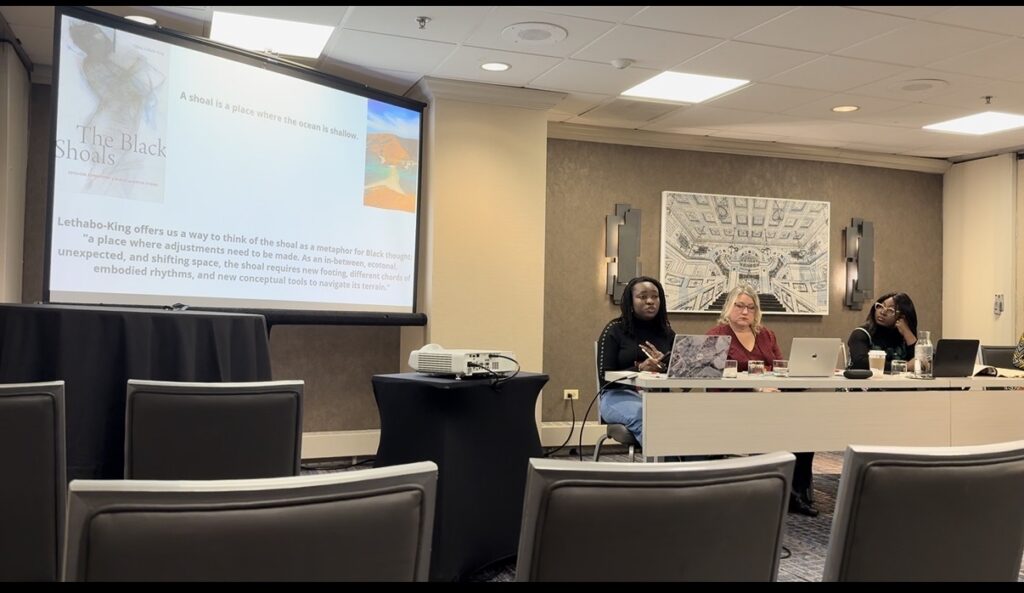
I attempt a strategic rearticulation of African feminist decolonial thought through a critical reimagining of Tiffany Lethabo-King’s concept of shoaling to understand how undersea digital infrastructures map onto both colonial geographies and the routes of transatlantic slavery. A shoal is a place where the ocean is shallow, one of the worst nightmares of sailors. While Lethabo-King uses this metaphor to make a case for offshore formations of Black and Indigenous thought, she pulls us back, albeit briefly to 1441, and the continental land imaginaries and indigeneity of enslaved people. Lethabo-King offers us a way to think of the shoal as a metaphor for Black thought: “a place where adjustments need to be made. As an in-between, ecotonal, unexpected, and shifting space, the shoal requires new footing, different chords of embodied rhythms, and new conceptual tools to navigate its terrain.” At the shoal, Black oceanic and indigenous land imaginaries (both from 1441 and from 1492) may meet in generative ways that deemphasize colonial categories of belonging and center relationalities of experience.
We may then read the physical and metaphorical significance of Google’s Equiano cable – connecting Portugal to South Africa with branches in Togo, Nigeria, St. Helena, and Namibia – as one operating as a technological shoal, a formation that simultaneously disrupts and reveals the persistence of colonial violence in digital forms. Just as shoals historically marked points where enslaved Africans last touched continental soil before the Middle Passage, these cables materialize as sites where land-based exploitation meets oceanic histories of violence.
By bringing African feminist continental thought offshore to meet Black/Afro-Caribbean feminist oceanic imaginaries, new forms of African feminist decolonial thought emerge, enabling theoretical formations at the intersection of land and sea, digital and physical labor, and historical and contemporary forms of exploitation. The undersea cables themselves become literal and metaphorical shoals – points where overglossed narratives of technological progress are disrupted, where corporate attempts to whitewash colonial history through naming practices accumulate like sediment, and where resistance emerges.
In his autobiography, The Interesting Narrative of the Life of Olaudah Equiano, or Gustavus Vassa, the African (1789), we encounter Equiano, who was born in the Igbo community in what is now southeastern Nigeria1 and was kidnapped and forced aboard a slave ship at age 11.
In his own words, Equiano writes: “The first object which saluted my eyes when I arrived on the coast was the sea, and a slave ship, which was then riding at anchor, and waiting for its cargo. These filled me with astonishment, which was soon converted into terror when I was carried on board… I was handled and tossed up to see if I were sound by some of the crew; and I was now persuaded that I had gotten into a world of bad spirits, and that they were going to kill me… When I looked round the ship too and saw a large furnace or copper boiling, and a multitude of black people of every description chained together, every one of their countenances expressing dejection and sorrow, I no longer doubted of my fate; and, quite overpowered with horror and anguish, I fell motionless on the deck and fainted…. The closeness of the place, and the heat of the climate, added to the number in the ship, which was so crowded that each had scarcely room to turn himself, almost suffocated us…. I was named Olaudah, which, in our language (Igbo), signifies vicissitude or fortune also, one favoured, and having a loud voice and well spoken.” Throughout his journey from his Benin homeland to the Virginia colony and later England, he would be given three different names: ‘Michael,’ ‘Jacob,’ and ‘Gustavus Vassa.’
In her seminal essay, “Mama’s Baby, Papa’s Maybe” Black feminist scholar Hortense Spillers unpacks how legal and grammatical codes created a system where personhood for enslaved people was impossible. Naming became a site of violence and stillness where the “captivating party does not only ‘earn’ the right to dispose of the captive body as it sees fit, but gains, consequently, the right to name and ‘name it.’” Here, just like the codes of slavery, Google’s naming of the cable “Equiano” represents a corporate appropriation and imposition upon Equiano’s identity that not only reduces him to corporate branding but also enacts a grammar of digital colonialism by claiming ownership over Equiano’s own name while confining this emblem to the bottom of the ocean. As Spillers argues and Equiano vividly describes, the slave’s flesh was the site of human and social irreparability, “that zero degree of social conceptualization that does not escape concealment under the brush of discourse.” I argue that Google’s naming of the cable performs a task of concealing the “flesh” – “its seared, divided, ripped-apartness, riveted to the ship’s hole, fallen, or ‘escaped’ overboard” – it reenacts the violence of the Middle Passage that Equiano documented.
We are especially reminded of the relationality of these cables and the encounters they enable at local, national, and global levels. Google is not the only company involved in this practice. There exists a covert structure of digital colonialism, from Big Tech’s “bridging the digital divide” narratives to Silicon Valley’s material exploitation through African sweatshops in Kenya, that perpetuates a saviorist rhetoric eerily mirroring the logic of saviorism that enabled the colonization of the continent. These cables compel us to look into the ocean and trace the unfreedoms it drags offshore. I argue that an African feminist decolonial thought emerges from these shoals, where resistance to digital colonialism must account for both land-based and oceanic forms of exploitation and critically interrogate how contemporary technological “advancements” perpetuate historical patterns of violence, while asking us to enthusiastically adapt to these signifiers of modernity or risk being left behind.
From the works of practitioners like Esther Mwemba, Abeba Birhane, Chinasa Okolo, Kauna Malwgwi, Irene Mwemdwa, Ann Holland, and several others, we are seeing a work in progress, but nonetheless an active reimagining of digital futures by African women across multiple scales from institutional pressures on the African Union and African governments, critical consciousness-raising and radical education, alternative technological advancements, unionizing, and pan-African feminist solidarities. We would do well to listen.
- Scholars, especially Vincent Carretta, have raised doubts about the veracity of Olaudah Equiano’s account of his childhood in Africa, and suggested that he may have been born in South Carolina based on baptismal records and naval muster rolls. However, this conclusion still remains disputed by other scholars who argue that the evidence supports Equiano’s claim of being born in Nigeria.